PRESERVING CAPE HERITAGE AND CULTURE THROUGH EXPLORING VISUAL ARTS AND EDUCATION

06-22 August 2026
Walkabout 22 August 2026 at 12pm
EXHIBITION
ONLINE PHYSICAL

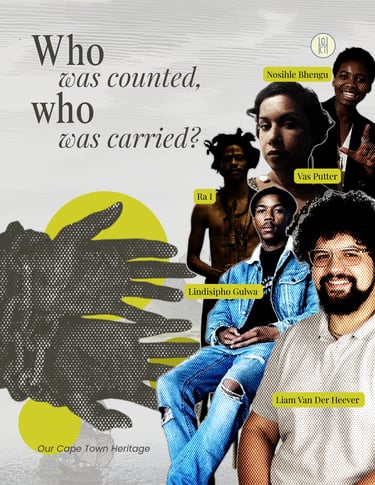
WHO WAS COUNTED, WHO WAS CARRIED
CURATORIAL BY AALIYAH AHMED
For many South Africans, we were told our history began only when our ancestors arrived with the tide, as if no public or private histories existed before. This exhibition brings together an eclectic group of artists who interrogate the procedures of remembering. Who is granted a monument, and who is shoved into the drawer?
Who Was Counted, Who Was Carried asks us to reconsider how history is recorded and remembered. It questions who has been deemed worthy of recognition within official narratives, while honouring those whose lives, labour, memories, and resilience have been carried across generations despite their exclusion from the historical record. We ask who was physically “counted”: documented, named, and acknowledged with dignity, and who was never considered worthy of being counted at all. Conversely, we ask who was “carried”; not only by boat across oceans, but through oral histories, cultural practices, family stories, objects, and the collective memory of communities who preserved what official histories overlooked.
In this exhibition, the artists, Liam Van Der Heever (Cape Town), Lindisipho Gulwa (Cape Town), Nosihle Bhengu (Cape Town), Vas Putter (Durban) and Ra I (Cape Town) each ask, “How do we carry the past when the archive is erased or incomplete?” Their works reveal what and who each artist chooses to remember, as an attempt to fill the gaps of an incomplete archive. In remembering differently, the artists honour those intentionally excluded from the archive. This exhibition moves through five modes of memory: domestic memory (Liam van der Heever), romanticised or fond memory (Lindisipho Gulwa), frozen memory (Nosihle Bhengu), discarded memory (Vas Putter) and inherited memory (Ra I).
Liam Van Der Heever uses drawers as spaces of both remembrance and confrontation. Drawing from personal experiences of Coloured identity and shared histories of oppression, they preserve everyday objects that carry memories of joy, resilience, loss, and survival. In doing so, the work validates lived experience while challenging viewers to confront the legacies of colonialism and apartheid that continue to shape contemporary South African society.
Lindisipho Gulwa’s exploration of home, memory, and cultural identity gives visual form to histories often overlooked, contributing to the exhibition’s interrogation of whose lives and experiences are remembered, and whose continue to be carried across generations. Through colour and movement, his work evokes personal and collective memory, foregrounding histories that persist.
Nosihle Bhengu’s layered archival imagery and spatial interventions, explores how the enduring legacies of slavery and colonialism continue to shape contemporary landscapes, bodies, and collective memory. The work positions memory as an embodied act of resistance, where the ocean, architecture, and land become living archives of trauma, migration, and resilience. By revealing what has been obscured or forgotten, the practice invites viewers to confront the persistent presence of the past and reimagine spaces of remembrance, healing, and justice.
Vas Putter is fascinated with the diaspora of peoples and the displacement of artefacts. Her work explores humanitarian and environmental issues while also unpacking narratives of historical and contemporary slavery. Putter states, “Everything we do, say, buy, discard is layered in connection and consequence. Everything we touch has a ripple effect. The viewer is invited to see through the illusion by peering out of the veil.” Looking beyond the surface, her work echoes the exhibition’s exploration of memory, visibility, and the enduring weight of colonial and apartheid histories.
Ra I’s practice centres on preserving memory and culture through stories that connect past, present, and future. Drawing from the visual language of ‘Bushman’ rock art, urban graffiti, and realism, his work bridges ancestral knowledge with contemporary expression. Drawing on historical memory, oral tradition, and ancestral knowledge, the artist reimagines pivotal moments of African resistance to colonial invasion. Their practice foregrounds the spiritual, cultural, and political dimensions of these histories, positioning ancestors, healers, and warriors as active custodians of collective memory. Through evocative narrative imagery, the work challenges colonial historical accounts while affirming resilience, Indigenous knowledge systems, and the enduring relationship between land, lineage, and liberation.
Who Was Counted, Who Was Carried does not offer a complete history; it dwells in fragments, interrupted stories, carried memories, and lives beyond the boundaries of official record. In a city shaped by arrival, displacement, and reinvention, the exhibition seeks to find what has been preserved, what has been erased, and what still endures beneath Cape Town’s surface. It reminds us that history is found not only in monuments and archives, but also in homes, rituals, objects, bodies, and stories passed quietly between generations. The question is not only who was counted, but who bore the weight of being forgotten, and who continues to carry these histories forward.
Through OCTH Archival Research by Yunus Ogier, we invite you to research into the lives of sailors and enslaved people in the early Cape, which reveals a city shaped by constant movement, labour, and inequality. While both were essential to the colonial economy, they were treated as expendable, their lives reduced to records of work, discipline, and loss. By reading these archival traces closely, we begin to recover the humanity of those long kept at the margins.


ONLINE EXHIBITION
VAS PUTTER
All descriptions are the artists' reflection on the meaning of their work


NOSIHLE BHENGU


RA I


LINDISIPHO GULWA


LIAM VAN DER HEEVER


Discover
Contact Us
Our cultural heritage matters
Help us learn and grow by sharing your respectful feedback on our website, exhibitions, social media and more:
Store's Terms and Conditions